Are You Doing Too Much for Your Dog? When Enrichment Becomes Another Job
Are you wondering if your dog is getting enough exercise, mental stimulation, enrichment, training, and attention?
Do you feel guilty when you skip a puzzle toy, shorten a walk, or spend an evening doing absolutely nothing with your dog?
I understand.
Somewhere along the way, I think many of us started treating our dogs’ happiness like a full-time job.
And if you have a fearful or reactive dog, the pressure can feel even heavier. You are already thinking about triggers, safety, dog body language, fearful dog training, and how to help your dog feel more confident.
Now you are also supposed to be your dog’s personal entertainment director?
Friend, you can put the chicken wieners down for a minute. 🐾
The foundation of relationship: leadership, relevance, and fulfillment
At Beyond Obedience, I talk about the foundation of relationship as having three parts:
Leadership
Relevance
Fulfillment
Fulfillment is the piece I want to explore today.
Because I think we have made it much more complicated than it needs to be.
Instead of asking, “Am I doing enough for my dog?”, I want you to ask:
> “What actually fulfills the dog standing in front of me?”
That is a very different question.
It moves you away from checking boxes and toward understanding your individual dog.
Enrichment and fulfillment are not the same thing
Dog enrichment can be wonderful.
Snuffle mats, food puzzles, scent games, training activities, long walks, and novel experiences can all give your dog opportunities to use their body, brain, and natural behaviors.
But stimulation and fulfillment are not the same thing.
You can stimulate the hell out of a dog and still not fulfill them.
A dog can be busy all day and still feel overwhelmed, frustrated, disconnected, or unable to settle.
A fulfilled dog is not simply a tired dog.
Fulfillment is about creating a life where your dog can feel safe, understood, connected, and able to express who they are.
That may include enrichment.
But it also includes rest, predictability, shared experiences, autonomy, and the opportunity to simply be part of your life.
When enrichment becomes another job
I used to work in biomedical research, where we talked about enrichment all the time.
In that setting, animals lived in highly contained environments. Their world was limited, controlled, and very different from the environment they would naturally experience.
So enrichment was used to provide opportunities to express more natural behaviors.
That makes sense.
But lately, I have wondered whether we have taken that idea and turned it into another responsibility for dog lovers to carry.
Another thing to buy.
Another activity to plan.
Another game to play.
Another box to check.
You hear that your dog needs:
More mental stimulation
More physical exercise
More enrichment
More training
Brain games
Food puzzles
Snuffle mats
Breed-specific activities
Novel experiences
A job
More socialization
And suddenly, you are asking yourself:
Did I do enough today?
Are they bored?
Should I have trained more?
Do I need to buy another toy?
Before you know it, your relationship with your dog starts to feel like a list of services you provide.
But having a fulfilled dog does not mean spending your entire life doing things for your dog.
Don’t confuse the product with the need
A snuffle mat is not a need.
A puzzle toy is not a need.
A lick mat is not a need.
These are tools.
They can give dogs opportunities to express certain behaviors, and they can be useful tools in the right context. For some dogs, they are especially helpful when weather, health, housing, or safety limits outdoor activities.
But the product is not the point.
The need is underneath the product.
So instead of asking, “What enrichment should I buy?”, ask:
> “What behavior is my dog actually seeking?”
Is your dog looking for opportunities to:
Search?
Investigate?
Chase?
Dig?
Carry?
Chew?
Climb?
Move?
Watch?
Connect with you?
Rest without interruption?
That question gives you much more useful information than a shopping list.
What does the dog in front of you find fulfilling?
Take terriers.
I love me a terrier.
Terriers were developed to search, seek, pursue, grab, shake, and kill. They have strong instincts and a particular way of interacting with the world.
They were not developed to figure out little plastic doors containing freeze-dried liver.
Now, that does not mean a plastic puzzle is bad.
It means the puzzle is not the point.
The point is understanding what makes the dog in front of you come alive.
What do they naturally seek out?
What do they keep returning to?
What completely absorbs them?
What makes their body soften and their eyes brighten?
You may not need to manufacture an activity. You may simply need to notice what is already happening.
Outside already exists
We have created indoor products for dogs to sniff, search, dig, climb over, investigate, and explore.
Meanwhile, outside exists.
There are parks, trails, beaches, sidewalks, patches of grass, piles of leaves, fallen trees, and fascinating smells that your dog considers the discovery of the century.
You do not need acres of land to give your dog meaningful experiences.
Even a suburban sidewalk has information written all over it in scent.
Of course, I recognize that not everyone has easy access to safe outdoor spaces. Some dogs are too fearful or reactive for busy parks. Weather, mobility, and neighbourhood challenges are real.
This is not a judgment.
But sometimes we do not need to create more.
Sometimes we need to slow down enough to notice what is already there.

My personal inside-and-outside philosophy
I am going to say something that may not be your thing.
Inside my house, I prefer quiet time.
I do not manufacture outdoor activities indoors. I do not want hunting, searching, and high-energy shenanigans happening throughout the house.
Outside is where we explore.
Inside is where we rest.
This is especially helpful in multi-dog households. When several dogs share a space, clarity about what happens where can make daily life feel much easier.
My dogs know that the house means calm, rest, and peaceful movement.
That does not mean they must lie perfectly still. They have autonomy. They can move around and choose where they want to be.
It simply means that outdoor activities happen outside.
That is my preference, not a universal rule.
Take what you need and leave the rest. You do you, boo. 🐾
The important thing is not whether your house looks like mine.
The important thing is that your expectations make sense to your dog.
Clarity matters more than constant calmness. Predictability does not mean you can never change your energy or voice. It means your responses make sense in context.
Quiet inside makes sense in my home.
Urgent movement or a stronger voice may make sense when safety requires it.
That kind of clarity helps your dog understand what is happening.
Fulfillment is about relationship
Have you ever said something like:
“Go sniff. Fill your boots. I’ll stand over here and check my messages.”
I hear this idea often.
The dog gets their sniff time, while the human waits nearby.
That can be fine sometimes. Your dog does not need you involved in every single second of their exploration.
But what if you occasionally became part of what your dog already finds meaningful?
If your dog finds a hole fascinating, go look at it with them.
Get curious.
If they are investigating a smell, stop for a moment and notice what has captured their attention.
You do not have to sniff it yourself. Although if you do, please send me a picture. I would love that.
You can simply join their experience.
Do not control it.
Do not immediately turn it into a training exercise.
Just be there.
Your dog spends most of their life operating in our human world. Sometimes it is good for us to enter theirs.
That shared experience can be more valuable than another activity purchased online.
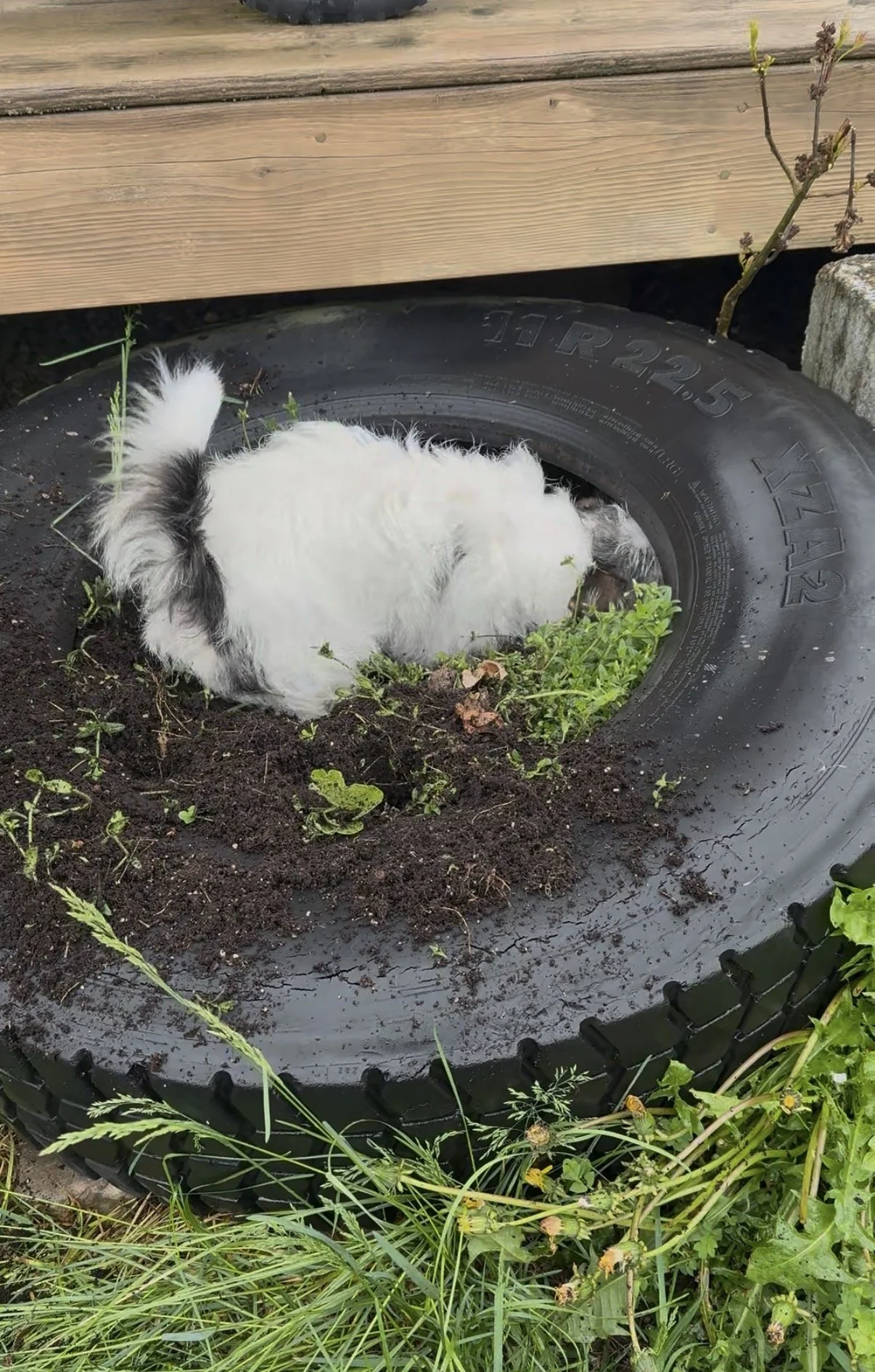
created her own “digging spot”
This week’s assignment: buy nothing
I have an assignment for you this week, and it may save you some money.
Do not buy anything.
Do not Google “best enrichment activities for German Shepherds.”
Do not search for “best brain games for terriers.”
Just watch your dog.
Step 1: Notice
What does your dog already love doing?
What do they investigate?
What do they keep returning to?
What makes them come alive?
Step 2: Get curious
Pay attention without immediately interrupting, redirecting, or controlling.
What information is your dog gathering?
What behavior are they trying to express?
Step 3: Share the experience
Ask yourself:
> “Is there a way I can be part of this with my dog?”
Not train it.
Not manage every detail.
Not turn it into another assignment.
Just share it.
This is useful for every dog, including dogs working through reactive dog training, fearful dog training, or dog behavior modification.
It can also help you rethink loose leash walking tips. Instead of seeing the walk as a test of obedience, consider how you can become part of the environment your dog already finds valuable.
You do not have to do more
If you have been feeling guilty because you are not providing enough enrichment, I hope you can take a breath.
Your dog does not need a perfect schedule packed with activities.
Your dog needs a thoughtful partner who is willing to adapt, notice, and build trust through shared experiences.
That is leadership.
Being present.
Being responsive.
Being clear.
Being willing to understand the dog standing in front of you.
And, as always, being what you want your dog to be.
If life gets lifey and today is a quiet day, that is okay.
A peaceful house, a safe walk, a shared moment, and a good sleep can be deeply fulfilling.
Here for you! 🐾
Want support understanding your dog?
If you are tired of second-guessing what your fearful or reactive dog needs, I would love to invite you into the Fearless Framework.
Inside, we focus on trust, leadership, confidence, communication, and understanding what is happening beneath the behavior.
You can also connect with a supportive community of dog lovers in the Living Beyond Obedience Facebook group.
Listen to Episode 232
Want to hear the full conversation, tangents and all?
Need help with your dog?
If you are dealing with dangerous behavior or feel completely out of your depth, please seek hands-on support from a qualified professional in your area.
You can also contact Beyond Obedience and tell us a little about what is happening.
You are not alone in this.
We can walk the journey together. 👣
Tracy XOXO
Frequently asked questions about dog enrichment and fulfillment
What is the difference between dog enrichment and fulfillment?
Dog enrichment refers to activities or tools that give your dog opportunities to use their senses, body, brain, and natural behaviors. Fulfillment is the broader outcome of a life that meets your dog’s needs for safety, rest, connection, predictability, choice, and meaningful experiences.
Does my dog need enrichment every day?
Dogs need opportunities to move, explore, rest, connect, and express natural behaviors. That does not mean you need to provide a new activity every day. Ordinary walks, shared experiences, sniffing, play, rest, and being part of family life can all be meaningful.
Can too much mental stimulation be bad for dogs?
Yes. More stimulation is not always better. If your dog becomes restless, frustrated, unable to settle, or more reactive after activities, they may need less intensity and more recovery time. The goal is not to keep your dog busy; it is to support a life that feels safe and manageable.
What is the best enrichment for a fearful or reactive dog?
The best enrichment depends on the individual dog. Start with activities that feel safe, predictable, and enjoyable. This may include quiet sniffing, simple exploration, chewing, resting, or low-pressure shared experiences. Avoid forcing activities or placing your dog in environments that overwhelm them.
Does my dog need puzzle toys?
No. Puzzle toys are optional tools, not requirements. They may be useful for some dogs, but they are not a substitute for understanding what your dog naturally finds meaningful.
How can I tell what fulfills my dog?
Watch your dog without immediately directing them. Notice what they seek, investigate, repeat, and enjoy. Look for relaxed engagement, curiosity, and the ability to settle afterward. Then consider how you can safely share some of those experiences.
Be the person your dog thinks you are.