Stop Telling Your Dog "No" Until You've Done This
Have you ever heard yourself say:
“No barking.”
“Stop it.”
“No!”
“I said no barking!”
…and then watched your dog continue doing exactly what you told them not to do?
Same, friend. Same.
I have said “no” too quickly more times than I can count.
The question is not whether you are allowed to say no. You are.
The question is this:
Did you actually tell your dog what you wanted them to do instead?
Because there is a big difference between telling your dog what not to do and communicating what you want them to do.
Sometimes we say no before we have given our dogs an opportunity to say yes.
And that little shift can change everything in dog training.
Why “No” Often Does Not Work
A dog cannot do nothing in a vacuum.
“Don’t bark” does not automatically tell your dog whether you want them to:
Come away from the window
Follow you into another room
Lie down
Look at you
Stand quietly beside you
Move away from the trigger
Your dog needs useful information.
If all they hear is “stop,” “don’t,” or “knock it off,” they may understand that you are unhappy.
But they may have no idea what choice would make things better.
That is not a communication problem because your dog is stubborn.
It is often a communication problem because we have not yet explained the answer.
The Light Bulb Moment From a Fearless Framework Call
This idea came up during one of our Fearless Framework coaching calls.
We were talking about a dog barking at deer.
And the deer were actually there.
The dog was not barking at an imaginary threat or being difficult for the sake of it. The dog noticed something in the environment and responded.
I said something I had never explained quite that way before:
You cannot really say no until you have asked your dog to do something else.
After the call, my friend Paisey told me she had watched a few faces on the Zoom call go “ohhh.”
You know the moment.
The little light bulb comes on.
Because suddenly, “no barking” sounds very different.
Your Dog May Not Be Wrong
Before you write me an email saying, “Tracy, my dog barks at a leaf,” let me clarify.
I am not saying every behavior is appropriate.
I am not saying your dog should bark at the window for 45 minutes.
I am not saying dogs should be allowed to do whatever they want.
What I am saying is this:
Your dog’s behavior makes sense based on the information available to your dog.
We humans are very eye-dominant.
If we do not see something, we tend to assume it is not there.
But your dog may hear something you cannot hear.
They may smell something you cannot smell.
They may notice movement, shadows, or changes in the environment that you completely miss.
Your inability to perceive what your dog perceived does not mean there was nothing there.
Try putting a sticky note near the window where your dog barks.
Write:
> Your dog is right. Just because you cannot see it does not mean it does not exist.
That does not mean your dog gets the final say.
It means you begin the conversation with curiosity instead of instantly deciding your dog is wrong.
That matters, especially when you are working through fearful dog training, anxious behavior, or dog reactivity.
Start With “Thank You”
When one of my dogs alerts me to something, I often say, “Thank you.”
That does not mean I want them to continue barking forever.
It means:
“I heard you.”
“You noticed something.”
“Thank you for letting me know.”
Sometimes I will go and see what they are looking at.
Maybe I already know it is a deer.
Maybe I cannot see anything at all.
Either way, I have acknowledged the information my dog gave me.
Then comes the part many of us miss.
I tell my dog what I want them to do next.
The “Thank You, Then Come With Me” Pattern
Try thinking through the interaction like this:
Your dog barks.
You acknowledge them: “Thank you.”
You investigate or look toward the trigger.
You ask for a behavior your dog understands.
You notice whether they choose to follow your direction.
You respond to that choice.
For example:
“Thank you. I see the deer. Come on, let’s go this way.”
Your dog follows you away from the window.
“Yes, good job. Let’s go.”
Now you have had an actual exchange of information.
Your dog told you something.
You acknowledged it.
You asked for something.
Your dog made a choice.
You responded.
That is dog communication.
That is a relationship.
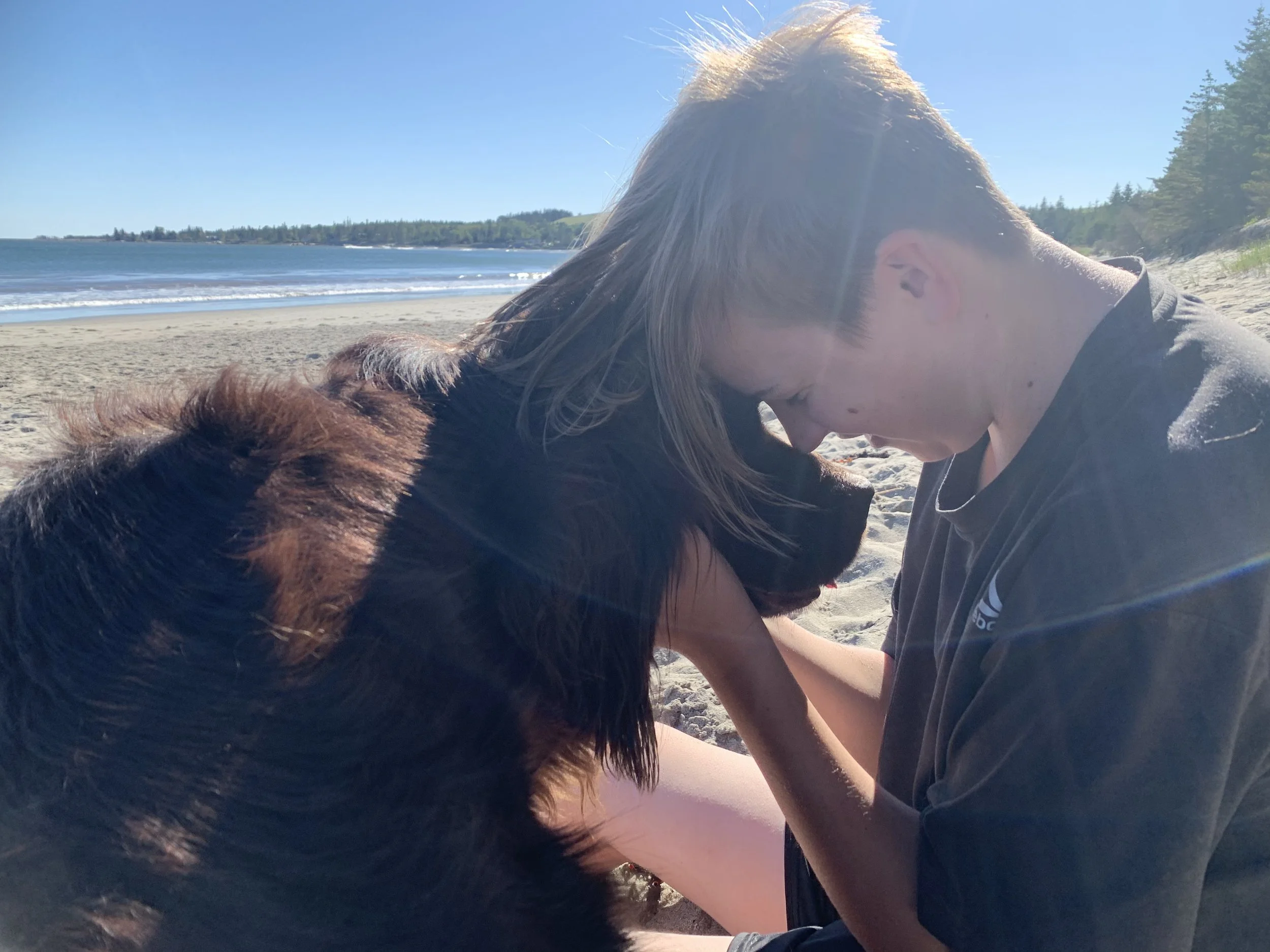
I do not use a lot of formal commands with my own dogs.
Often, I use my voice, body language, and hand gestures.Your Dog Cannot Follow a Cue They Do Not Know
This part is important.
You cannot suddenly say, “Go to your mat!” during a barking explosion if your dog has never learned what that means.
You cannot pull a random cue out of thin air and then become frustrated when your dog looks at you like:
“What mat? What are we doing? Is this a new game?”
Use something your dog actually understands.
That might be:
“Come with me.”
“Let’s go.”
Moving with you when you use a familiar hand signal
Following you into another room
Lying down in a space they already know
Moving away from a window or doorway
I might say, “Come back with me. Let’s go do that,” and then move toward another room.
When I settle, they often settle too.
And that brings us to an important point:
The goal is not constant calmness. The goal is clarity.
Sometimes safety requires an urgent change in energy or voice.
If your dog is about to run into danger, you may need to be loud, direct, and fast.
Predictability does not mean you always sound exactly the same.
It means your response makes sense in context.
You are present, responsive, and clear.
“No” Is Not the Problem
I tell my dogs no.
I have a regular no.
I also have a “hell no.”
There is absolutely a difference.
There are things my dogs would like to do that I am not going to allow.
That is part of living together.
The problem is not the word no.
The problem is using no as your entire communication system.
There is a huge difference between:
> “No. Stop. Don’t.”
And:
> “I hear you. Here is what I would like you to do instead.”
If your dog ignores the clear request you have made, now you can disagree.
You might say:
“No, I asked you to come. Let’s go this way.”
Then you follow through calmly and safely.
That is different from standing across the room yelling “no barking” while your dog has no idea what they are supposed to do.
What About Dog Reactivity?
This applies to reactive dog training, too.
When your dog sees another dog, person, bike, or trigger, do you find yourself pulling back and saying:
“No, no, no, no, no!”
I understand.
Your dog reacts, your heart jumps into your throat, and suddenly you are trying to solve everything at once.
But pause and ask:
What do I actually want my dog to do right now?
Maybe you want them to:
Move with you
Create distance
Look back at you
Turn away from the trigger
Walk beside you
Leave the situation
“Walk nicely beside me” may be what you want.
But have you practiced that behavior?
Does your dog know what it means when a trigger is right there?
A dog who can walk beautifully in the kitchen may not be capable of loose leash walking beside another dog at close range.
That is not failure.
It is information.
If your plan does not work, notice the outcome and move on.
Create more distance.
Lower the intensity.
Choose a simpler behavior.
Try again when your dog has a better chance of succeeding.
That is thoughtful dog behavior modification.
Give Your Dog a Chance to Be Right
If all we ever communicate is what we do not want, we are not giving our dogs much useful information.
Worse, we are not giving them an opportunity to be right.
Before you correct your dog for getting something wrong, ask:
Did I actually give them the opportunity to get it right?
When you disagree with your dog, you are disagreeing with a choice they made.
But if you never gave them a choice, how would they know?
This is especially important when you are wondering, “Why won’t my dog listen?”
Sometimes your dog is not refusing a clear request.
Sometimes they have not understood the request.
Sometimes the environment is too intense.
Sometimes the behavior has not been practiced enough to work in that context.
Good leadership is not constant obedience.
It is being present, predictable, responsive, and clear.
It is building trust through shared experiences.
It is learning to be what you want your dog to be.
Your “No” Challenge This Week
This week, catch yourself the next time you say “no.”
Pause for half a second and ask:
What did I actually want my dog to do?
Did I tell them?
Do they know how to do that behavior?
Did I give them an opportunity to choose it?
What is their body language telling me right now?
No blame.
No judgment.
I still catch myself, too.
Gunther gets excited and jumps on me, and honestly, it hurts.
My first automatic response is often, “No!”
Then I have to remember to ask myself what I want him to do instead.
Do I want him to move away?
Stand beside me?
Keep his paws on the floor?
I am working on this, too, friend.
We can walk the journey together.
A Calmer Way to Communicate With Your Dog
If your dog barks at the window, start with acknowledgment.
If your dog reacts on a walk, start with safety and space.
If your anxious dog is overwhelmed, do not expect a complicated behavior in the middle of the storm.
And inside your home, keep the environment as quiet, calm, and peaceful as you reasonably can.
Home does not need to become a high-energy training arena.
You do not need to practice hunting, seeking, or searching games indoors if those activities wind your dog up or encourage constant scanning and alerting.
Your dog needs a place to come down.
A peaceful home gives both of you room to think.
For more support with fearful, anxious, or reactive dogs, you are warmly invited to join the Fearless Framework, connect in the free Living Beyond Obedience Facebook group, or contact Beyond Obedience.
You can also listen to the full episode here:
Episode 235: Stop Telling Your Dog “No” Until You’ve Done This on Apple Podcasts
Before you correct your dog for getting it wrong, give them a chance to get it right.
Here for you, friend. 🐾
Frequently Asked Questions
Why does my dog bark at nothing?
Your dog may be hearing, smelling, or seeing something you cannot detect. Dogs have different sensory abilities from humans, so barking at “nothing” may be a response to information that is real to your dog. If the barking is sudden, intense, or unusual, speak with your veterinarian or a qualified behavior professional.
Is it bad to tell my dog no?
No. The word “no” is not automatically bad. The problem is using “no” as your only communication. First acknowledge what your dog is experiencing, then clearly tell them what you want them to do instead. If they ignore a behavior they understand, you can calmly disagree and follow through.
How do I stop my dog from barking?
To learn how to stop dog barking, first identify why your dog is barking. Acknowledge the alert, investigate when appropriate, and ask for a known alternative such as coming away from the window, following you, or settling in another space. Avoid yelling “no barking” without giving your dog a clear behavior to perform.
What should I do when my dog reacts on a walk?
Create distance from the trigger and ask for a behavior your dog knows, such as moving with you or turning away. Do not expect a complex cue if your dog is already overwhelmed. Reactive dog training works best when you adjust the environment so your dog can notice the trigger without immediately going over threshold.
Why won’t my dog listen to me?
Your dog may not understand the request, may not know the behavior in that context, or may be too stressed to respond. Ask whether you have taught the behavior, practiced it around distractions, and given your dog a fair opportunity to choose it. “Why won’t my dog listen?” is often a useful invitation to become more curious about what your dog needs.
How do I teach my dog what to do instead of what not to do?
Choose one clear alternative behavior and practice it when your dog is calm. For example, teach your dog to come with you, move away from a window, lie on a bed, or follow a hand signal. Reward the behavior you want, gradually practice around mild distractions, and adjust your plan when your dog struggles.
Be the person your dog thinks you are.