Your Dog Said No. Now What?
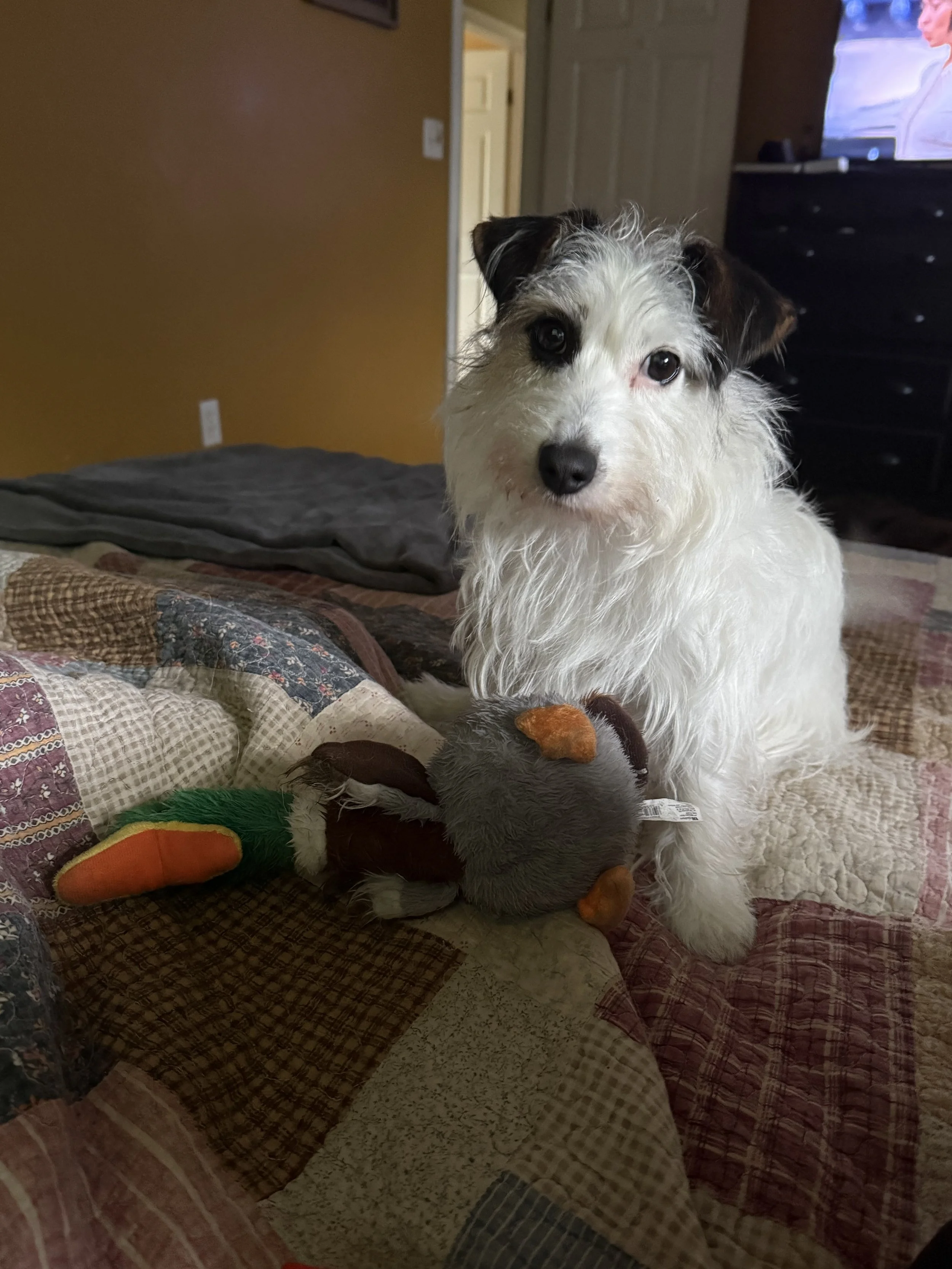
Your dog pulled their paw away.
Maybe they moved when you reached toward them. Maybe they froze, turned their head, licked their lips, or made it very clear:
“I don’t want you to do this.”
Now what?
If you love your dog, these moments can leave you feeling stuck. You want to respect their communication. You also know that some things, like nail care, veterinary treatment, medication, grooming, and safety, cannot always be optional.
I’ve been there too.
I’ve worried about getting it wrong. I’ve wondered whether listening to my dog meant I had to stop every time they disagreed. I’ve also seen how quickly things can go sideways when we decide, “I’m the human. We’re doing this whether you like it or not.”
Neither extreme creates the relationship most of us want.
A healthy relationship can include disagreement.
What does it mean to respect your dog’s “no”?
There are two common extremes when it comes to dog consent and autonomy:
“I’m human, you’re a dog, so we’re doing this.”
“My dog said no, so I can never do it.”
But respecting your dog’s no does not mean your dog always gets the final answer.
It means their communication changes the conversation.
Sometimes the answer is:
“Okay, not today.”
“Let’s find another way.”
“Let’s change the tool.”
“We’ll try one nail instead of all of them.”
“I hear you, and this still needs to happen.”
That last one can feel uncomfortable.
But listening is not the same as complying.
Being heard is not the same as getting your own way. That is true in healthy human relationships, too.
Your dog’s body language matters. Their discomfort matters. Their preferences matter.
And sometimes, their welfare or safety matters more than their preference in that specific moment.
Nail trims: when your dog hates having their nails done
Nail trimming is a perfect example.
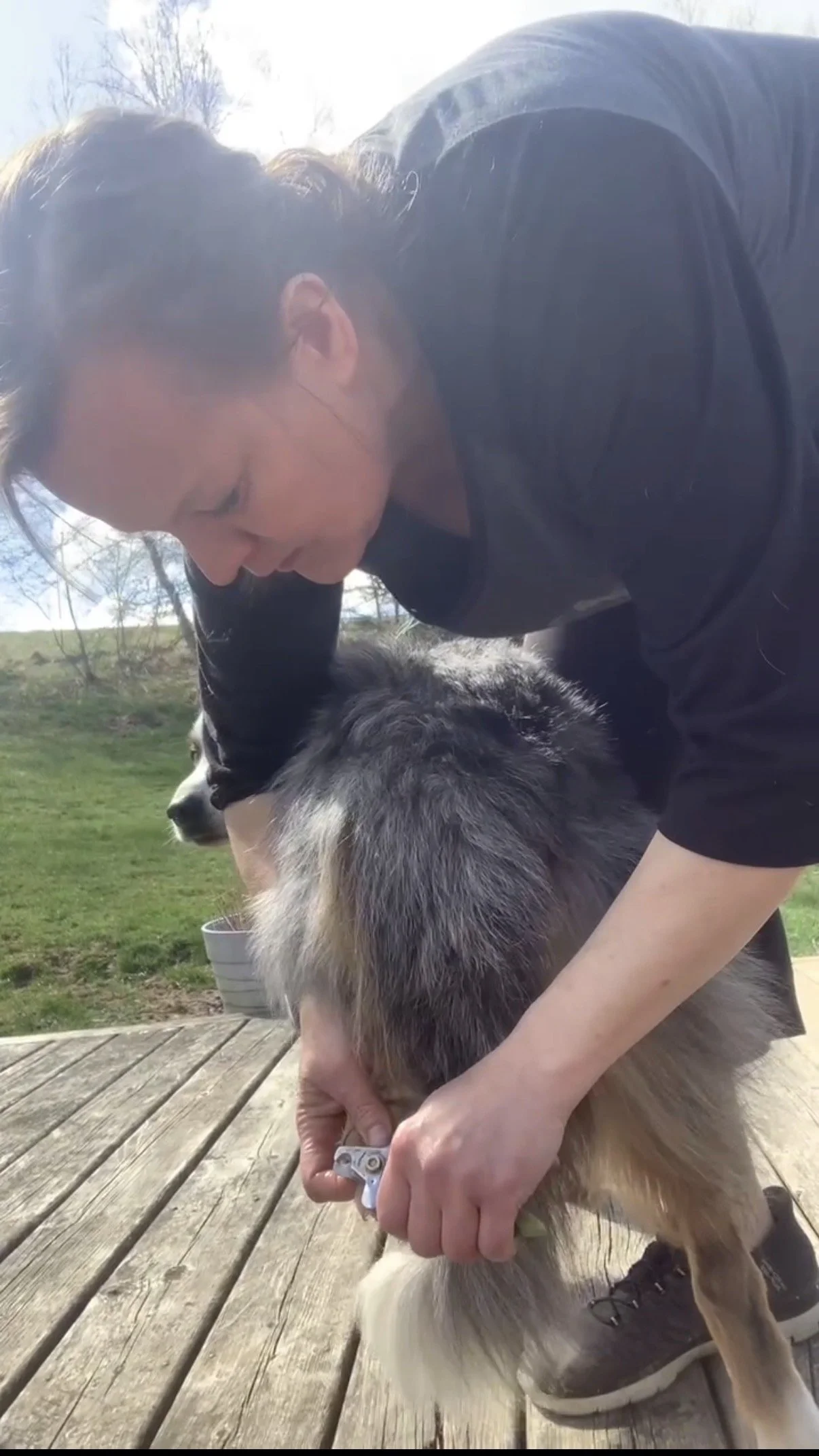
There is so much emotion wrapped up in it for both of you. Your dog may hate the clippers, the Dremel, the restraint, or the feeling of having their paw held.
And you may be carrying your own worry.
What if I cut too far? What if they pull away? What if I make this worse?
I understand.
One of the students inside the Fearless Framework found a brilliant solution for many of her dog’s nails: a scratch board. Her dog scratches at the board as a game and naturally wears down his front nails.
No forcing. No panic. No dramatic nail-trimming battle.
But then there are the dewclaws.
Dewclaws don’t usually touch the ground or the scratch board. They can grow too long, catch on things, tear, or scratch. At some point, maintaining them becomes a welfare issue.
So what do you do when your dog still says no?
You start by asking a better question:
What is my dog actually communicating, and what can I change before I ask them to tolerate more?
Build a calm handling baseline first
Before you worry about how to trim a dog’s nails that hates it, start with something much simpler:
Can your dog relax while you touch their feet?
The goal is for foot handling to mean absolutely nothing.
No clippers hidden behind your back. No surprise procedure. No bait and switch.
Just touching.
I’m a former veterinary technician and dog groomer, so I’m constantly checking my dogs. I spread their toes. I look under their paw pads. I check their nails. I inspect ears, teeth, and all the little places that dogs probably wish I would leave alone.
But I don’t turn every relaxed cuddle into a procedure.
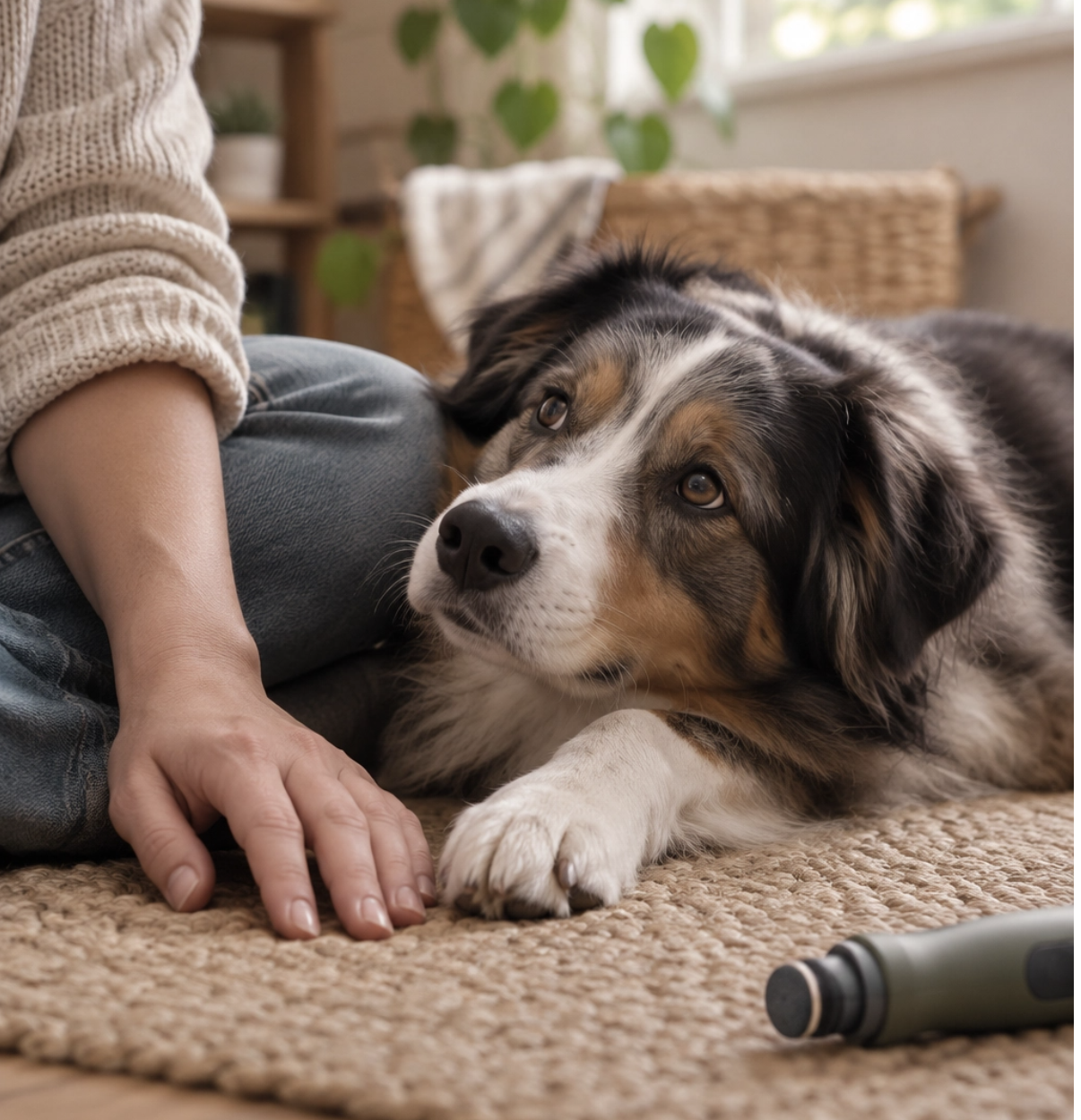
If your dog is sensitive to having their feet touched, start with approach and retreat:
Reach toward the paw.
Stop before your dog becomes uncomfortable.
Move away.
Let your dog experience, “I didn’t die, and the scary hand went away.”
Repeat gradually over time.
You may only touch the leg at first. That’s okay.
Trust is built through small, consistent moments where your dog’s communication has an effect.
Never use relaxed cuddles as a bait and switch
Imagine your dog is curled up beside you on the couch.
They’re soft. Relaxed. Trusting.
You gently touch their paw every evening. Then, one day, you suddenly pull out the nail clippers and start trimming.
That is a bait and switch.
Your dog may learn that relaxing beside you is no longer safe because the rules can change without warning.
Instead, use those quiet moments to add predictable language:
“I’m just touching your paw.”
“I’m just checking your nails.”
“I’m just looking at your toes.”
“I’m not doing anything else.”
Then bridge those words to a separate, clearly defined grooming routine.
For me, nail clipping is an event.
I say, “It’s nail clipping time.”
The tools come out. The context changes. Everyone knows what is happening.
Predictability does not mean I always sound calm and cheerful. If safety requires an urgent change in energy or voice, I can be clear and decisive. What matters is that my response makes sense in context.
That is leadership.
Being present, predictable, responsive, and clear, not demanding constant obedience.
What your dog’s “no” can teach you
Years ago, while grooming my Newfoundland, Wellington would sometimes gently place his mouth over my hand and the brush when the brush snagged a mat.
It wasn’t a bite.
It was a conversation.
He was saying, “I don’t like where this is going.”
I would acknowledge him, ask him to remove his mouth, and change my technique or tool.
Sometimes the answer was simple:
“Yep. I hear you. We’re stopping.”
But not every “no” means the same thing.
There is a difference between:
“I would prefer you didn’t use the Dremel.”
“I never want you to maintain my nails again.”
The first may be something you can accommodate by changing tools, positions, or timing.
The second may become a welfare concern.
Your dog does not get to make every decision about veterinary care, medication, grooming, emergency safety, or getting into the car when you need to leave quickly.
But how you respond still matters enormously.
How you handle the disagreement matters
Two people can perform the same procedure and create completely different experiences for the dog.
When a dog pulls away, our natural human response can be to hold tighter.
The dog pulls harder.
We grip harder.
The dog fights harder.
And suddenly, we are no longer listening. We have decided, “This is happening, and we’re getting it done.”
Instead, try this:
Pause and notice the communication.
Ask whether you can change the tool, position, timing, or number of repetitions.
Give your dog a moment to process.
Do less if less is enough.
If the care genuinely must happen, stay steady and help them through it.
You may not complete every nail.
That does not mean you failed.
Sometimes the outcome is the same, but the experience is completely different.
Your dog may learn:
“When I struggle, my human gets angry.”
“When I say no, nobody listens.”
“Once my human decides something, communication is over.”
Or they may learn:
“My human heard me.”
“My human stayed steady.”
“My human made adjustments when possible.”
“When something must happen, my human helps me through it.”
That second lesson is trust building.
The deeper kind of trust
There is a kind of trust we don’t talk about enough:
How much trust does it take for your dog to let you make a decision they disagree with?
This is not learned helplessness.
It is not holding a dog so tightly that they give up because they have no other option.
The intent matters.
The message is:
> “I hear you. I know you don’t want this. We still have to get through it, and I’m going to support you.”
That is very different from:
> “Your no doesn’t matter.”
Your dog can learn that their no matters even when the final answer cannot be yes.
That is a profound level of trust.
Step-by-step: what to do when your dog says no
Step 1: Get curious
Look at the dog body language signs in front of you.
Are they pulling away, freezing, turning their head, licking their lips, stiffening, or trying to leave?
Treat that information as communication, not defiance.
Step 2: Ask what can change
Can you use a different tool?
Can you change your hand position?
Can you do one nail instead of twelve?
Can you try later?
Can you ask a fear-free veterinarian or skilled groomer for help?
Step 3: Decide what is necessary
Some things can wait.
Some things need another approach.
Some things must happen because leaving them undone would compromise your dog’s health or safety.
Be thoughtful. Be willing to adapt. Then make the clearest decision you can.
Step 4: Choose who you will be
If the answer is still no and the care genuinely needs to happen, who will you be while it happens?
Frantic?
Angry?
Forceful?
Or steady, responsive, and supportive?
Be what you want your dog to be.
Your relationship is a Trust Bank
If you’ve been learning about dog consent and autonomy, you may now be terrified of getting anything wrong.
You may finish one difficult interaction and think:
Did I just ruin everything?
No, friend. You probably didn’t.
Think of your relationship like a Trust Bank.
Every time you listen, adjust, respect discomfort, and respond predictably, you make a deposit.
One difficult interaction does not erase every deposit.
A relationship is not defined by one disagreement. Healthy relationships have to be able to withstand disagreement.
Your dog lives in Humansville. There will be moments when they experience something they would not choose.
We are not trying to create a life where your dog never encounters discomfort.
We are building a relationship where your dog knows:
“My communication matters, even when my human cannot give me exactly what I want.”
The final question to ask when your dog says no
Next time your dog says no, don’t immediately jump to:
“Too bad. I’m the boss.”
And don’t collapse into:
“Okay, then I’ll never do it.”
Get curious.
What are they telling you?
Can you choose something different?
Can you make the next step smaller?
Can you pause?
And if this genuinely needs to happen, ask yourself:
Who am I going to be while it happens?
Trust is not built by never doing anything your dog dislikes.
Trust is built, in part, by how you show up when something difficult has to happen.
Sometimes the greatest demonstration of trust is not your dog happily agreeing.
It is your dog saying:
“I don’t want this, but I trust you. So let’s get through it together.”
If you want support understanding your dog’s communication and navigating fear-based behavior, you can learn more about the Fearless Framework, contact me directly, or join our Living Beyond Obedience community.
This conversation is also a natural companion to episode 235, “Stop Telling Your Dog No Until You’ve Done This,” and you can listen to episode 238, “Your Dog Said No. Now What?” on Apple Podcasts.
Here for you, always. 🐾
Be the person your dog thinks you are.
Frequently asked questions
What does it mean to respect my dog’s autonomy?
Respecting your dog’s autonomy means noticing their communication, acknowledging discomfort, avoiding unnecessary force, and adjusting your approach whenever you can. It does not mean your dog makes every decision, especially when health or safety is involved.
Should I always stop when my dog says no?
Not always. First, pause and assess. Some things can wait or be changed. Other things, such as urgent veterinary care or necessary nail maintenance, may need to happen. The goal is to listen and respond: not automatically comply or ignore your dog.
How do I trim my dog’s nails if they hate it?
Begin by building comfort with foot handling separately from nail trimming. Introduce tools gradually, use very small steps, and consider trimming one nail at a time. Scratch boards may help with some nails. If your dog is highly fearful, seek support from a qualified professional or fear-free veterinary team.
Is it okay to restrain my dog for grooming or veterinary care?
Sometimes gentle, skilled restraint is necessary for welfare or safety. Restraint should not mean pinning a dog down until they shut down. It should involve thoughtful handling, appropriate support, and a plan to reduce fear over time. For dangerous or highly fearful behavior, seek hands-on professional guidance.
How do I build trust with a dog who does not like handling?
Start with tiny, predictable interactions that do not lead to a surprise procedure. Touch briefly, retreat before your dog becomes overwhelmed, and let their communication change what happens next. Trust grows through many consistent moments: not one perfect training session.
Did I ruin my relationship by forcing something my dog did not want?
One difficult interaction usually does not ruin a relationship, especially when you have built a strong foundation of trust. Reflect on what happened, make a plan for next time, and continue showing your dog that you listen, adapt, and remain steady.